Strategy & Foresight
Scenario Planning & Future Trends
Strategic foresight for uncertain operating environments
A structured foresight programme in which participants build, test and stress-test scenarios for their own organisation rather than analysing someone else's.
The challenge
What this programme addresses
Most planning cycles assume a broadly predictable future. Leadership teams then meet regulatory change, supply-chain shocks, technology shifts and sustainability pressures with a single forecast and no rehearsed alternatives. This programme addresses that gap: it gives participants a disciplined method for working with uncertainty, distinguishing genuine drivers from noise, and testing whether current strategy holds up under conditions other than the expected one.
Audience
Who it is for
- MBA, EMBA and professional masters cohorts
- Senior and mid-career managers with planning responsibility
- Strategy, risk, sustainability and policy teams
- University and business-school partners seeking a foresight module
Outcomes
What participants can do afterwards
- 01
Identify and rank the critical uncertainties shaping an organisation's environment
- 02
Build a small set of internally consistent, decision-relevant scenarios
- 03
Wind-tunnel existing strategy against those scenarios and score its robustness with evidence
- 04
Distinguish trends, tipping points and weak signals in practice
- 05
Translate foresight work into early-warning indicators and concrete decisions
- 06
Present and defend a foresight case to a sceptical audience
Learning experience
How it is taught
The module is run as a working studio. Short conceptual framing is followed immediately by group work on a live context, then by structured challenge from other groups and from the faculty. Participants are expected to justify judgements with evidence rather than intuition, and to revise their thinking when challenged.
- Driver mapping and uncertainty ranking on a real organisational context
- Scenario construction in small teams, with defined narrative discipline
- Wind-tunnel workshop: strategies are tested against each scenario and scored
- Peer challenge rounds in which groups stress-test each other's assumptions and shocks
- Written and presented foresight outputs with individual accountability
- Reflection on how the method transfers back into the participant's own planning cycle
Possible formats
- Half-day executive briefing (introductory)
- Two-day intensive workshop
- Three-weekend modular format for working professionals
- Full credit-bearing postgraduate module
- In-house version built around a client's own strategic questions
Evidence & examples
Where this has been delivered
Taught most recently as Scenario Planning and Trend Analysis (SM97.01) at the Asian Institute of Technology, School of Management, June 2026, co-delivered with Mr Sam Hanna. The course recorded an evaluation score of 99.83% across 15 returned forms from 17 credit students (88.24% participation).
“His teaching style was structured, practical, and encouraged us to challenge our assumptions rather than simply look for the "right" answer. This mindset is something I will continue to apply in my professional career.”
“Effective facilitation of the wind-tunnel workshop, pushing groups to justify robustness scores with evidence rather than intuition.”
“Strong expertise and extensive experience in sustainability and strategic foresight. His lectures encouraged critical thinking and helped students look beyond short term solutions.”
Faculty
Who delivers it
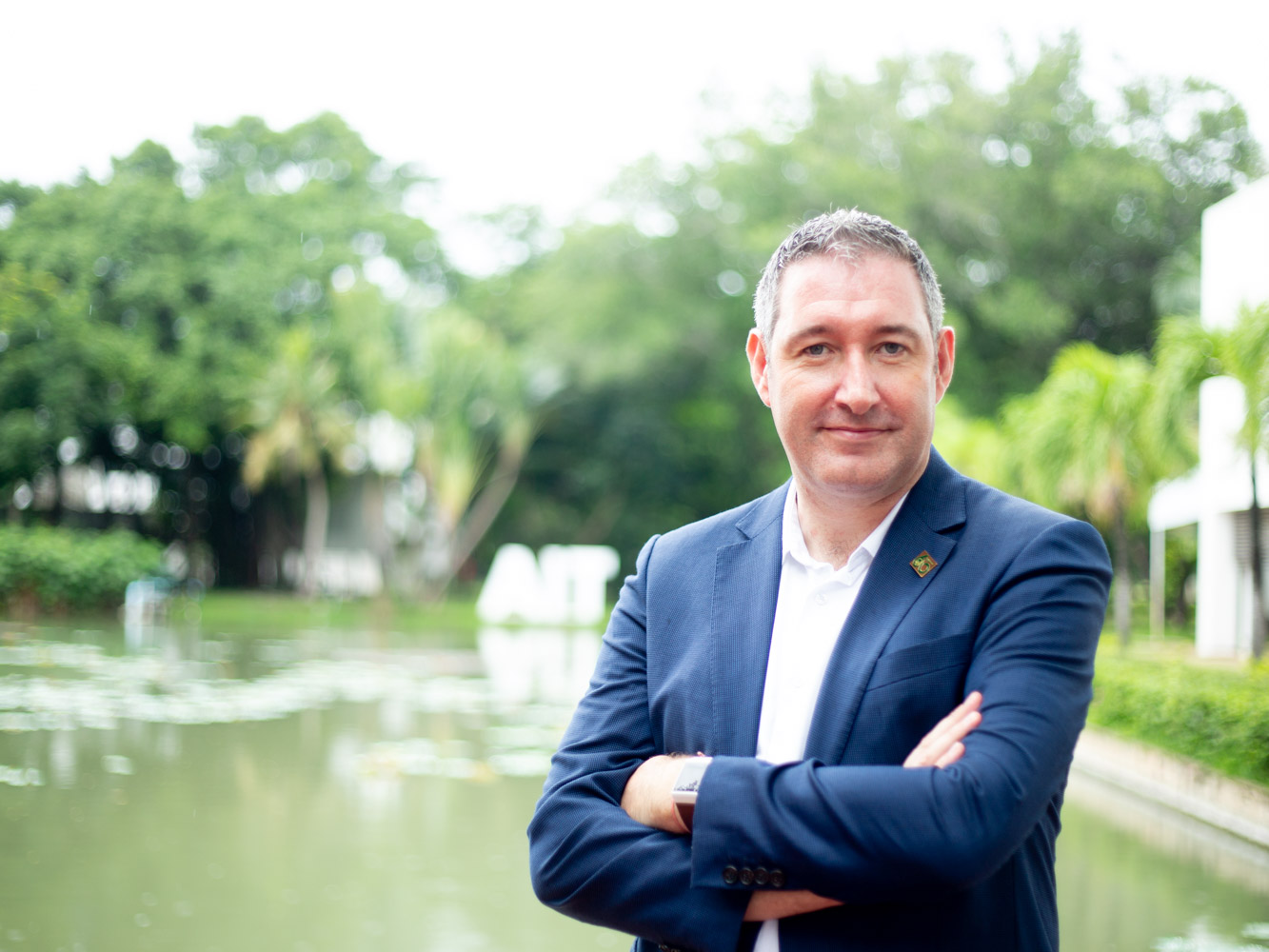
Led by Dr Roger Levermore, who has taught strategy, ESG and scenario planning on MBA and executive programmes at HKUST Business School, CUHK Business School and the Asian Institute of Technology. Additional faculty can be brought in for sector-specific sessions where a client requires it.
Related
Other programmes
Enquire about Scenario Planning & Future Trends
Tell us the audience, the format you have in mind and the questions you want participants to leave able to answer.